Industrial operations rely on equipment that must perform without interruption. A single equipment failure can idle crews, delay shipments, and disrupt production schedules within minutes. Even one hour of unplanned downtime can result in lost output, contractual penalties, and rising labour costs.
When a critical machine fails, production stops, and costs rise quickly. For construction sites, manufacturing plants, and logistics hubs, equipment reliability directly affects profitability. If your business depends on heavy equipment, access to trusted commercial towing services in Edmonton becomes part of operational risk planning.
Heavy machinery towing is not just about transport. It is about restoring workflow, protecting high-value assets, and preventing extended financial loss. Below are eight real-world situations where heavy machinery towing keeps industrial operations running.
Equipment Breakdown on Active Construction Sites
Construction projects operate on tight schedules. Every trade depends on heavy equipment working on time. When an excavator or loader fails, crews sit idle and coordination suffers. Labour costs increase by the hour.
Delayed earthwork can postpone inspections and concrete pours. Equipment rental extensions increase project expenses. Contractors may face liquidated damages under strict timelines.
Heavy machinery towing removes failed equipment quickly. It allows off-site repair while replacement equipment arrives. This protects timelines and reduces contract penalties.
Machinery Failure During Peak Production
Manufacturing plants cannot afford extended stoppages. Production lines often operate on fixed output targets. Even short disruptions affect delivery commitments.
Equipment such as forklifts, compressors, and generators must function consistently. A failed forklift can halt internal material movement. A disabled compressor can shut down entire processes.
Employers are responsible for ensuring that the workplace is safe and that hazards are identified and controlled.
When heavy machinery fails, safe removal becomes a priority. Blocked aisles and unstable equipment increase safety risk. Professional heavy equipment towing ensures controlled relocation without creating additional hazards.
Semi Truck Breakdown at Distribution Hubs
Distribution centers depend on continuous truck movement. Loading bays operate on scheduled arrivals and departures.
A stalled tractor unit can block multiple docks. Drivers waiting in the queue lose time and productivity. Late shipments can trigger supply chain disruption.
Heavy-duty truck towing in Edmonton restores traffic flow quickly. Rapid removal reduces congestion and warehouse backlog. For logistics managers, that speed directly protects revenue.
Equipment Stuck in Mud or Uneven Terrain
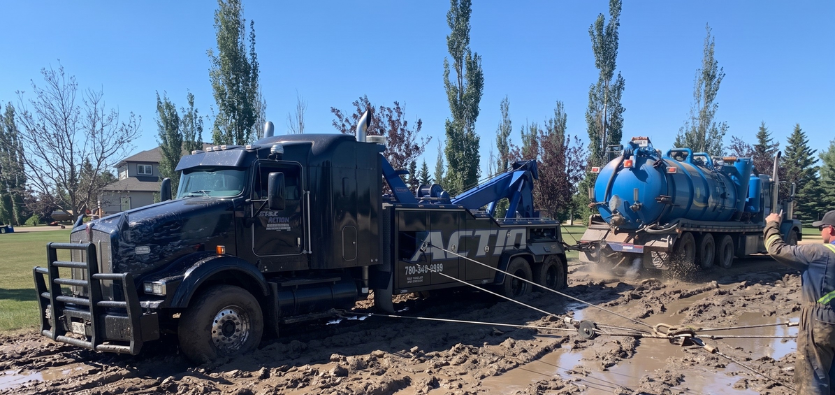
Industrial sites in Alberta face unpredictable ground conditions. Freeze-thaw cycles weaken surface stability. Heavy machinery can sink or become immobilized.
Improper recovery attempts often cause frame distortion or hydraulic strain. Unplanned extraction may also endanger workers nearby.
Employers must ensure that work site equipment is used and maintained in a safe condition. Heavy equipment recovery prevents unsafe improvisation. Controlled towing protects machinery, operators, and site productivity.
Overturned Machinery or Load Shift Incidents
Overturned equipment presents immediate operational and safety concerns. Weight distribution changes increase rollover risk during recovery.
Improper lifting can cause structural bending or additional component damage. Recovery must follow calculated rigging methods.
Professional vehicle recovery services use stabilization techniques and heavy capacity winches. They reduce strain on structural points and protect high-value assets. This approach also supports smoother insurance documentation.
Long Distance Equipment Relocation
Industrial projects often require moving machinery between sites. Relocation may involve highways, rural routes, or restricted access roads.
Improper transport can damage suspension systems and sensitive components. Secure loading and route planning are critical.
The safe transportation of dangerous goods protects people, property and the environment. While not all machinery falls under dangerous goods regulations, transport safety principles still apply. Long-distance heavy-duty towing in Edmonton ensures secure loading, route assessment, and compliance awareness.
Emergency Failure on High Traffic Highways
Highway breakdowns increase exposure to moving traffic. Commercial vehicles create blind spots and lane blockages.
Extended stoppages increase accident risk and liability exposure. Delays may also attract enforcement attention.
Emergency towing services in Edmonton secure the vehicle quickly. Fast removal restores traffic flow and reduces secondary collision risk.
Image 3
Fleet-Wide Equipment Failures During Extreme Weather
Severe cold affects hydraulics, batteries, and fuel systems. Electrical failures often occur simultaneously across fleets.
Multiple disabled units strain internal maintenance capacity. Delayed response increases idle time across operations.
Coordinated commercial fleet recovery ensures structured dispatch and priority handling. This reduces downtime across multiple vehicles and supports business continuity planning.
Why Professional Heavy Machinery Towing Matters
Industrial operations depend on precision and planning. Heavy machinery represents substantial capital investment.
Improper towing can damage axles, frames, and suspension components. Secondary damage increases repair timelines and costs.
Professional heavy-duty towing services in Edmonton use specialized tow trucks, rigging systems, and trained operators. This expertise reduces mechanical stress and protects long-term asset value.
Investing in professional support lowers risk exposure and avoids preventable repair expenses.
Choosing the Right Towing Company in Edmonton
You need a towing partner with verified commercial experience. Industrial equipment requires appropriate towing capacity and securement methods.
Look for a towing company in Edmonton that handles heavy-duty fleet operations. Confirm response availability and insurance coverage.
Strong communication ensures coordinated dispatch during critical events. A prepared partner reduces operational uncertainty.
Conclusion
Heavy machinery towing protects more than equipment. It safeguards schedules, workforce efficiency, and contractual commitments.
When equipment fails, response speed directly influences financial impact. Businesses that prepare with reliable heavy-duty towing in Edmonton reduce disruption and protect long-term operational stability.
About Us
Action Towing has supported Edmonton businesses for years. The company focuses on heavy-duty towing and commercial fleet recovery. Industrial clients rely on experienced operators and specialized heavy-capacity equipment.
If your organization requires dependable support, visit Action Towing to understand its commercial capabilities. You can also contact us to discuss operational requirements.
Commercial vehicle incidents rarely happen in controlled environments. Trucks slide off shoulders, equipment sinks into unstable ground, and loaded units lose traction without warning.
These situations create immediate pressure on drivers and dispatch teams. Recovery methods must be built for weight, risk, and precision when commercial vehicles are involved.
Many fleet operators plan for these scenarios by understanding professional commercial towing services in Edmonton before incidents occur. Early preparation allows teams to respond with confidence instead of urgency. It helps reduce downtime and prevents rushed recovery decisions that can increase operational disruption.
Winch-out recovery is one of the most complex commercial towing operations. It requires controlled pulling while stabilizing a disabled vehicle under challenging conditions.
This blog explains why winch-out recovery depends on heavy-duty capability in commercial environments. It also shows how proper equipment helps protect assets and maintain business continuity.
Understanding Winch Out Recovery In Commercial Towing
Winch-out recovery involves pulling a disabled vehicle from an unsafe position when it cannot move under its own power. This can include ditches, embankments, snow-packed shoulders, or uneven job sites where traction is lost. In these situations, controlled recovery becomes the only safe option.
Commercial vehicles add another layer of complexity to this process. Their size and load create significantly higher recovery forces that must be managed carefully. Improper pulling increases rollover risk and can cause serious structural damage to both the tractor and trailer.
Heavy-duty equipment allows operators to apply controlled force throughout the recovery process. This level of control protects the vehicle and the surrounding area from unnecessary stress. Precision remains critical at every recovery stage, especially when working in high-risk environments.
Commercial Vehicle Weight Exceeds Standard Recovery Limits
Commercial vehicles weigh far more than passenger vehicles, especially when fully loaded. Loaded tractor-trailers place extreme stress on recovery systems during winch-out operations. Standard winches are not built to sustain this level of continuous force.
Heavy-duty winches are designed for long-duration recovery under heavy load. They maintain steady pulling pressure without sudden strain or power loss. This consistency protects frames, axles, and attachment points from structural damage.
Weight distribution also plays a major role in recovery stability. Heavy-duty systems allow gradual repositioning while maintaining balance. This controlled approach reduces secondary damage and supports safer recovery outcomes.
Recovery Angles Require Controlled Pulling
Winch-out recovery often occurs on slopes or uneven terrain where stability is already compromised. Ditches and embankments create unstable recovery angles that increase operational risk. When pulling is done incorrectly, rollover risk rises significantly.
Heavy-duty equipment supports adjustable pull angles that allow precise vehicle positioning. Operators can align vehicles properly before movement begins. This level of control prevents sudden shifts that could destabilize the unit.
Precision pulling reduces overall recovery hazards. It protects operators, nearby traffic, and the surrounding infrastructure. Heavy-duty capability makes this level of safety and control possible.
Load Stability Must Be Maintained During Recovery
Cargo movement presents a serious risk during winch-out recovery, especially when vehicles are loaded. Load shifts can damage trailers, strain frames, or cause rollovers if not properly controlled. Improper recovery techniques increase this risk and can lead to costly operational setbacks.
Heavy-duty systems stabilize both the tractor and trailer throughout the recovery process. Controlled tension limits sudden movement and reduces stress on connection points. This protection preserves cargo security and maintains overall vehicle integrity.
The Government of Canada emphasizes shared responsibility in commercial safety. Commercial vehicle safety is a shared responsibility among drivers, carriers, shippers and regulators. Maintaining load stability during recovery reflects this responsibility and supports safer industry practices.
Rigging Strength Is A Safety Requirement
Winch lines and rigging must match vehicle weight to ensure safe recovery operations. Underrated equipment creates dangerous failure points that increase the risk of sudden breakage. Line failure can cause severe injury and significant property damage.
Heavy-duty recovery uses purpose-rated rigging designed for commercial loads. Lines and anchors meet strict capacity standards and are tested for reliability. Redundancy within these systems improves safety margins during complex recoveries.
Alberta Workplace Safety Guidance reinforces the importance of hazard control in high-risk work environments. Employers must ensure that work is carried out safely and without health risk. Proper rigging practices support this obligation and protect everyone involved.
Recovery Speed Affects Traffic And Operations
Commercial recoveries often occur on active roadways where traffic continues to move nearby. Extended recovery time disrupts traffic flow and increases congestion. It also raises collision risk for drivers, operators, and emergency responders.
Heavy-duty equipment reduces on-scene time by delivering greater pulling power and control. Faster, controlled recovery allows vehicles to be repositioned efficiently. Road access is restored sooner, helping normalize traffic conditions.
Alberta transportation policy highlights the importance of roadway efficiency. Safe and efficient movement of people and goods is essential to Alberta’s economy. Efficient recovery directly supports this objective and limits economic disruption.
For many operators, early coordination with experienced heavy-duty towing professionals in Edmonton helps minimize operational disruption and maintain operational continuity.
Safety Protocols Depend On Purpose Built Equipment
Commercial recovery follows strict safety procedures that guide every stage of the operation. Operators often work near moving traffic and unstable terrain where conditions can change quickly. Equipment must support controlled execution in these high-risk environments.
Heavy-duty systems include safety-focused controls designed for commercial recovery. Redundant braking and controlled winching protect crews during complex operations. These features help reduce incident escalation and maintain site stability.
Improvised recovery increases risk exposure for operators and surrounding traffic. Heavy-duty equipment supports compliance, accountability, and professional standards. Safety remains the priority throughout every recovery process.
When Winch Out Recovery Should Be Initiated Immediately
Certain situations require early winch-out planning to prevent further damage. Loaded trucks in ditches often need stabilization before any movement begins. Construction equipment stuck on site also requires controlled extraction to avoid structural stress.
Winter conditions add another layer of complexity to recovery operations. Ice and snow reduce traction and increase recovery risk. Heavy-duty systems are designed to manage these conditions safely and consistently.
Early assessment helps prevent damage escalation and secondary incidents. Prepared recovery planning reduces downtime and supports faster operational recovery.
How Winch Out Recovery Supports Business Continuity
Commercial towing plays an important role in operational planning for fleet-based businesses. Breakdowns disrupt supply chains, delivery schedules, and service commitments. Recovery efforts must restore movement safely and efficiently to limit operational impact.
Heavy-duty winch-out recovery supports controlled resolution in complex situations. It protects vehicles, cargo, and surrounding infrastructure during recovery. This approach limits downtime and reduces secondary damage.
Fleet managers rely on predictable recovery outcomes to maintain consistency. Heavy-duty capability delivers reliability that supports long term operational performance.
About Us
Action Towing provides heavy-duty and commercial towing services across Edmonton. We support logistics fleets, construction operations, and commercial vehicle operators. Our focus is controlled recovery using purpose-built heavy-duty equipment.
Every winch-out recovery is handled with planning and precision. Our team prioritizes safety, load protection, and operational continuity.
To speak with our team, contact us today.
Commercial vehicles are responsible for moving goods, materials, and equipment across Canada every day. Transport trucks deliver products to warehouses, construction vehicles move materials to job sites, and fleet vehicles support businesses across cities like Edmonton.
When one of these vehicles stops operating unexpectedly, the impact can be immediate. Deliveries may be delayed, construction projects may pause, and logistics schedules can quickly fall behind.
In these situations, a dependable towing service becomes critical. Professional recovery teams ensure that disabled trucks, trailers, and heavy equipment can be removed safely and transported without causing further damage.
For companies that rely on transportation and logistics, a reliable towing service is not simply a convenience. It is a key part of keeping operations moving when unexpected roadside incidents occur.
Heavy vehicle recovery requires specialized equipment and trained operators. This is why businesses often depend on experienced professionals who understand how to manage complex recovery situations.
A professional towing service helps ensure that commercial vehicles can return to operation quickly and safely.
The Growing Importance of Professional Towing Services in Canada
Transportation activity continues to expand across Canada as businesses depend on trucks and commercial vehicles to maintain supply chains.
Construction companies move heavy equipment between job sites. Logistics operators transport goods between cities. Fleet vehicles operate across highways and industrial areas every day.
When mechanical failures occur, businesses need immediate support from a dependable towing service to minimize operational disruption.
According to statistics from Government Canada, the transportation and warehousing sector grew by 0.8 percent in March 2025, reflecting increased freight and transit activity across the country.
As transportation activity increases, the demand for reliable vehicle recovery services grows as well. A professional towing service ensures that commercial vehicles experiencing mechanical failures can be recovered quickly so operations can continue without major delays.
Experience in Heavy Vehicle Recovery
One of the main reasons businesses trust professional towing providers is experience.
Recovering heavy commercial vehicles requires more than basic roadside assistance. Trucks, trailers, and construction equipment often weigh several tons and must be handled carefully during recovery operations.
Operators must evaluate multiple factors before beginning a recovery operation, including:
- vehicle weight distribution
- axle configuration
- cargo stability
- road and environmental conditions
Experienced operators understand how to manage these variables safely. A professional towing service uses specialized recovery techniques that protect the vehicle while ensuring efficient transportation.
Specialized Equipment for Heavy Duty Towing
Heavy vehicle recovery requires advanced equipment designed specifically for large vehicles.
Professional towing companies invest in specialized tow trucks equipped with hydraulic systems, wheel lifts, and recovery booms capable of handling large loads.
This equipment allows operators to recover vehicles from difficult environments such as:
- busy highways
- construction zones
- industrial yards
- loading docks
With modern recovery equipment, a professional towing service can safely transport heavy vehicles without creating additional mechanical damage.
These advanced systems are essential for handling complex recovery situations involving commercial trucks and equipment.
Reliable Support for Commercial Fleets
Many businesses operate fleets of commercial vehicles that must remain operational every day.
When one vehicle breaks down, it can disrupt deliveries, service schedules, and logistics planning.
A dependable towing service helps businesses reduce downtime by recovering fleet vehicles quickly and transporting them to repair facilities.
Fleet towing services are commonly used by:
- logistics companies
- construction contractors
- transportation providers
- delivery services
Fast recovery ensures that companies can maintain productivity even when unexpected mechanical issues occur.
Accident Recovery for Heavy Commercial Vehicles
Vehicle accidents involving heavy trucks can create complex recovery situations.
Large vehicles may block traffic lanes, damage infrastructure, or carry unstable cargo loads.
Professional recovery teams use specialized equipment to stabilize vehicles and remove them safely from the roadway.
Accident recovery operations typically involve:
- vehicle stabilization
- controlled winching procedures
- cargo management
- roadway clearance
A professional towing service ensures that these recovery operations are conducted safely and efficiently.
Proper recovery procedures help protect drivers, vehicles, and surrounding traffic.
Why 24 Hour Towing Services Are Essential
Commercial vehicles operate across Canada around the clock. Trucks travel long distances across highways and industrial routes, often during overnight hours.
Breakdowns can occur at any time, making access to a reliable towing service essential. A professional towing provider offers 24 hour emergency response for situations such as:
- heavy truck breakdowns
- roadside accidents
- vehicle lockouts
- long distance towing
A quick response helps ensure drivers are not stranded for extended periods and vehicles can be transported safely.
The Importance of Safety in Towing Operations
Heavy vehicle recovery requires strict safety procedures. Commercial trucks and construction vehicles can weigh several tons, making recovery operations potentially hazardous if not handled correctly.
Professional towing operators follow careful recovery procedures that include:
- evaluating the recovery environment
- selecting proper towing equipment
- stabilizing vehicles before extraction
These safety practices help ensure that recovery operations are completed without causing additional damage.
A reliable towing service prioritizes safety for both drivers and nearby traffic.
Why Businesses Continue Choosing Professional Towing Services
Companies across Canada rely on transportation to maintain their operations. When vehicles break down, they need recovery providers they can trust.
Businesses value towing providers that deliver:
- fast emergency response
- modern heavy duty recovery equipment
- experienced operators
- safe and efficient vehicle handling
These qualities allow companies to recover vehicles quickly while maintaining operational continuity.
A dependable towing service becomes an important partner for businesses that rely on commercial transportation.
Final Thoughts
Commercial transportation plays a vital role in Canada’s economy. Trucks, trailers, and heavy equipment support industries ranging from construction to logistics.
When these vehicles experience mechanical failures or roadside incidents, reliable recovery support becomes essential.
A professional towing service provides the expertise, equipment, and rapid response needed to recover large vehicles safely.
Businesses that choose experienced towing providers gain peace of mind knowing that help is available whenever unexpected roadside situations occur.
About Action Towing
Action Towing has earned the trust of the Edmonton community by providing dependable heavy duty towing and commercial vehicle recovery services.
The company relies on skilled tow truck operators and modern equipment to handle complex recovery situations safely.
Services include commercial towing, fleet towing, semi truck recovery, equipment hauling, accident recovery, and emergency roadside assistance.
With a commitment to safety and reliability, the team continues to support businesses that depend on commercial transportation across Edmonton.
Commercial vehicles are the backbone of logistics, construction, and industrial operations across Edmonton. Every day, fleets of trucks, trailers, and equipment move materials, products, and machinery that keep businesses running. Yet one unexpected breakdown can disrupt an entire operation.
A stalled semi truck, a disabled trailer, or a damaged piece of equipment can halt work within minutes. Delayed shipments, paused construction projects, and blocked roadways create serious operational challenges.
This is where a professional towing company becomes more than roadside assistance. It becomes a vital operational partner that helps keep commercial transportation moving.
In a city like Edmonton, where heavy transport and industrial activity are constant, reliable towing services play a critical role in maintaining safety and efficiency on the road.
This guide explains how professional heavy duty towing services support commercial operations and why choosing the right towing company in Edmonton can make a major difference for businesses that depend on large vehicles.
Why Commercial Vehicles Require Specialized Towing Services
Not every breakdown involves a passenger vehicle. Many roadside incidents involve heavy trucks, construction equipment, or commercial transport vehicles.
These situations require specialized equipment and trained operators.
Heavy commercial vehicles weigh several tons and require advanced towing systems to handle them safely. Attempting recovery without proper equipment can create additional risks and damage.
Professional heavy duty towing service providers operate specialized tow trucks designed to manage large loads, complex recovery situations, and commercial transport vehicles.
Commercial vehicles that often require heavy duty towing include
- Semi trucks and tractor trailers
- Construction equipment
- Cube vans and delivery vehicles
- Class 3 trucks and work vehicles
- RVs and trailers
- Boats and transport trailers
Each vehicle requires a different towing approach depending on weight distribution, axle configuration, and road conditions. For this reason, businesses rely on experienced operators who understand how to manage large vehicle recoveries safely.
How Heavy Duty Towing Supports Commercial Operations in Edmonton
Edmonton is a major hub for construction, logistics, and resource transportation. Heavy vehicles operate across highways, industrial zones, and job sites every day.
Because of this constant activity, breakdowns and accidents involving commercial vehicles are inevitable.
A professional towing company Edmonton businesses rely on provides rapid response and specialized recovery services in these situations.
Key Benefits of Heavy-Duty Towing for Commercial Operations
Reduced Downtime
- Quick response towing helps businesses return vehicles to service faster.
Improved Road Safety
- Large disabled vehicles can create serious hazards on highways.
- Professional recovery helps clear roadways quickly.
Protection of Valuable Equipment
- Heavy trucks and machinery represent major investments.
- Professional towing ensures safe transport without additional damage.
Operational Continuity
- Reliable towing services help fleet operators maintain schedules and reduce disruptions.
- For businesses managing multiple vehicles, access to dependable towing Edmonton services becomes essential for keeping operations running smoothly.
Core Heavy Duty Towing Services for Commercial Vehicles
Professional towing companies offer a range of services designed specifically for large vehicles and commercial transport operations. These services ensure that different types of incidents can be handled safely and efficiently.
Semi Truck and Tractor Towing
Semi trucks are among the most common vehicles requiring roadside recovery. Mechanical failures, accidents, or cargo issues can leave these trucks stranded on major routes.
Professional heavy duty towing Edmonton providers use specialized tow trucks capable of handling the weight and structure of tractor-trailers.
These services ensure damaged or disabled trucks can be transported safely without compromising the vehicle or its cargo.
Fleet Towing Services
Fleet operators rely on consistent transportation to keep their businesses running. When one vehicle breaks down, an entire schedule can be affected.
Fleet towing services provide rapid support for commercial vehicle operators. Delivery trucks, service vehicles, and transport equipment can be recovered quickly and transported to repair facilities.
Reliable towing service providers often work directly with fleet managers to minimize operational disruption.
Equipment Towing and Hauling
Construction and industrial projects frequently require heavy machinery to be moved between job sites. Transporting this equipment requires specialized towing and hauling capabilities.
Professional towing companies often provide transport services for:
- Construction machinery
- Industrial equipment
- Agricultural machinery
- Heavy work vehicles
These services ensure that equipment reaches its destination safely without delays that could disrupt project timelines.
RV and Trailer Towing
Large recreational vehicles and trailers sometimes require heavy duty towing when mechanical issues occur during travel.
Because of their size and structure, RVs require specialized towing techniques. Professional operators use advanced towing systems to protect vehicles and ensure safe transport.
Boat Transportation
Boat transportation is another specialized service provided by experienced towing companies.
Boat trailers require careful handling to ensure stability during transport. Professional towing services ensure boats are transported safely between locations.
Accident Recovery for Large Vehicles
Not every towing situation involves a simple breakdown. Accidents involving commercial vehicles often create complex recovery situations.
These incidents may involve damaged vehicles, blocked roadways, or unstable cargo loads.
Professional accident recovery teams use specialized equipment such as tilt deck systems and heavy recovery trucks to stabilize and remove damaged vehicles safely.
Accident recovery services often include:
- Vehicle stabilization
- Cargo management
- Roadway clearance
- Transport of damaged vehicles
Efficient recovery helps restore traffic flow and reduce risks on busy roadways.
Why Businesses Depend on 24 Hour Heavy Duty Towing
Vehicle breakdowns rarely occur during convenient hours. Commercial vehicles operate day and night across Edmonton’s highways and industrial zones.
Because of this, access to 24 hour towing services is essential. A professional towing company must be prepared to respond at any time.
24 hour towing services help businesses by providing the following:
- Emergency roadside assistance
- Immediate vehicle recovery
- Rapid response for highway incidents
- Support during overnight transport operations
When fleets operate around the clock, reliable towing support becomes an important part of business continuity.
Equipment and Technology Used in Heavy Duty Towing
Modern heavy-duty towing services rely on advanced equipment designed to manage complex recovery operations.
Common heavy towing equipment includes the following:
- Tilt deck tow trucks
- Heavy duty flatbed carriers
- Wheel lift systems
- Hydraulic recovery equipment
Certified operators use these tools to recover and transport vehicles safely without causing additional damage.
This combination of specialized technology and operator expertise separates professional towing company Edmonton’s services from basic roadside assistance providers.
Choosing the Right Towing Company for Commercial Vehicles
Not every towing company has the capability to handle heavy commercial vehicles.
Businesses should work with towing providers that have proven experience in heavy duty recovery and commercial transport support.
Important Factors to Consider Include the Following:
Experience with Commercial Vehicles
- Heavy vehicles require specialized handling.
Certified Equipment
- Professional towing companies use equipment designed specifically for large vehicle recovery.
24 hour availability
- Commercial vehicles operate at all hours, making round-the-clock service essential.
Professional operators
- Skilled operators ensure safe vehicle handling and efficient recovery.
- Choosing the right towing partner helps businesses avoid delays, protect valuable equipment, and maintain operational efficiency.
Why Reliable Towing Matters for Edmonton’s Commercial Transport Industry
Edmonton’s economy relies heavily on the transportation, logistics, and construction industries.
Heavy vehicles move materials, machinery, and products across the region every day. Because of this, reliable heavy duty towing services play an important role in supporting these industries.
Industry data also highlights the economic importance of towing operations across Canada. According to Statistics Canada’s NAICS industry classification for motor vehicle towing (48841), businesses in this sector provide both light and heavy towing services to commercial operators, transportation companies, and the general public.
Recent industry statistics show that towing businesses generate average annual revenues of approximately $552,500, with around 75.2 percent of companies operating profitably. These figures demonstrate how essential towing services are for maintaining transportation networks and commercial operations.
Professional towing services ensure that disabled vehicles can be recovered quickly, preventing extended delays and maintaining safe road conditions.
A Trusted Towing Company Keeps Commercial Vehicles Moving
Vehicle breakdowns and accidents are an unavoidable part of transportation operations. However, their impact can be reduced when businesses rely on a reliable towing company equipped to handle heavy commercial vehicles.
Professional heavy duty towing services provide the equipment, expertise, and rapid response needed to recover large vehicles safely.
From semi truck towing to equipment transport and accident recovery, these services help keep Edmonton’s commercial transportation industry moving efficiently.
For businesses operating fleets, construction equipment, or transport vehicles, access to dependable towing Edmonton services is not simply a convenience. It is a necessity that supports productivity, safety, and operational continuity.
If your commercial vehicle experiences a breakdown or roadside emergency, professional towing support is available around the clock.
Contact a trusted towing company in Edmonton to ensure fast and safe recovery for your trucks, trailers, and equipment.
Commercial fleets in Edmonton face complex road risks every day. A breakdown or collision can do immediate harm. More often, the bigger loss comes from secondary damage that grows after the first incident.
Skilled commercial towing services prevent this extra harm and save companies time and money. Heavy commercial vehicles present unique safety challenges.
The Canada Motor Vehicle Safety Standards include specific safety requirements for commercial motor vehicles. These requirements cover brakes, lighting, and steering for heavy straight trucks and combinations. This helps reduce risks on highways and busy local roads.
In this blog, we will examine nine high-risk commercial scenarios where professional towing prevents secondary damage, reduces liability exposure, and protects business operations.
Each situation highlights how timely, well-planned recovery supports fleet reliability and long-term performance.
What Is Secondary Damage In Commercial Towing
Secondary damage refers to the additional loss that happens after the initial problem. The first failure might be a mechanical breakdown or a collision. But if recovery is delayed or mishandled, more harm can follow.
This harm can include cargo shift, structural stress to the vehicle frame, wheel damage, suspension failure, and equipment breakage. Commercial vehicles carry expensive goods and heavy loads. These secondary issues add repair costs and downtime.
Canada uses structured safety frameworks for commercial carriers that help reduce these risks. The National Safety Code Canada provides minimum operational and performance requirements for commercial vehicles. This structure supports safe operations for heavy trucks that travel long distances and carry large payloads.
1. Jackknifed Tractor Trailers On Highways
A jackknifed tractor-trailer blocks lanes and shifts immense force to the fifth wheel, suspension, and kingpin. The shifted force can damage the trailer structure and bent components. Cargo inside can slide and crush itself or the trailer walls.
If recovery crews pull without stabilization, the chassis can warp. Commercial towing crews first stabilize the unit, secure moving cargo, and then reposition the trailer. This method protects the load and prevents structural bending.
2. Loaded Trucks Stuck In Soft Ground Or Construction Sites
Commercial trucks often enter soft, uneven ground on job sites or unfinished roads. When wheels spin in these conditions, twist force can bend axles, deform leaf springs, and strain the differential.
Attempts by untrained responders to yank the truck free may cause additional frame damage. Professional recovery teams evaluate ground conditions, set proper winch points, and use multi-point controlled extraction. This protects both the vehicle and sensitive site surfaces.
3. Mechanical Failure On Active Commercial Routes
Heavy truck systems like brakes, transmissions, and steering fail under high stress. When this happens on busy routes such as the Yellowhead or Anthony Henday, the disabled truck becomes a traffic hazard. If the truck remains in a live lane, passing traffic may clip it.
This causes body panel damage, broken lighting, and wheel damage. Commercial towing teams quickly secure the scene, deploy traffic control measures, and remove the truck in a controlled way. This reduces further harm to the vehicle and other road users.
4. Shifted Or Unbalanced Loads During Transit
Load shift inside a trailer is one of the biggest dangers in commercial transport. When cargo breaks free or moves, it changes the centre of gravity. Uneven weight on axles can stress tires, suspension, and frame.
If a breakdown occurs with unbalanced cargo, the risk of rollover increases. During recovery, professional teams assess the load and perform load transfer if needed. They rebalance cargo and secure it so that moving the vehicle does not cause further damage.
5. Overturned Commercial Vehicles After Collisions
An overturned truck experiences complex forces that distort the body, crumple the roof, and stress the chassis. Fuel or hydraulic lines may break and pose hazards. If recovery starts without proper support points, the vehicle may twist further, making repairs more costly.
Commercial recovery teams use staged lifting and controlled rotation to right the vehicle. This sequence protects the body structure, cargo, and mechanical systems.
6. Heavy Equipment Breakdowns On Job Sites
Service trucks and equipment carriers often work where there is little clearance and uneven surfaces. When these vehicles break down, recovery is risky. Nearby cranes, compressors, and scaffolding may be hit by improper rigging.
Without planning, recovery can damage pricey site equipment or utilities. Commercial towing operators coordinate clearance paths, lifting points, and site protection. This reduces the chance of new damage during removal.
7. Winter Ice And Snow Immobilization
Edmonton winters bring snow, ice, and freezing temperatures. Heavy trucks can lose traction and slide into ditches, curbs, or barriers. Frozen brakes and air systems can stop working properly.
If crews pull a truck with poor traction aids, it can bend axles and misalign steering. Professional winter recovery uses traction devices, staged pulling, and awareness of ice layers. This prevents further damage to suspension components and maintains control of the vehicle.
8. Disabled Fleet Vehicles In High Traffic Zones
Fleet vehicles that stall near industrial access roads or main arteries are exposed to constant traffic pressure. Passing vehicles create vibration and wind impact that can break side panels and mirrors.
A stalled vehicle left too long may suffer broken lights, bent frames, or side door damage. Commercial towing dispatch prioritizes swift lane clearance with proper signalling and support. Removing the disabled unit quickly protects it and reduces road risk.
9. Long Distance Breakdowns With Sensitive Cargo
Long-distance commercial journeys often involve sensitive cargo such as refrigerated goods, machinery, or fragile products. A breakdown exposes cargo to temperature change and vibration stress, and may spoil goods or damage equipment.
Improper towing over distance adds wear to bearings, couplings, and suspension. Commercial towing teams plan recovery routes, use securement methods, and monitor cargo integrity. This protects goods, the truck, and operational timelines.
How Commercial Towing Prevents Secondary Damage
Commercial towing crews bring equipment and training that regular towing cannot match. They stabilize the vehicle, assess wave transfer or shift, and protect cargo. These teams follow safety procedures that align with Canada’s motor vehicle standards and expectations.
Skilled recovery limits further structural stress and protects fleet assets. This reduces company exposure to repair, liability, and downtime.
Why General Towing Creates Business Risk
General towing services are designed for light vehicles and short-distance recovery. They are not equipped to manage the weight, load dynamics, and structural demands of commercial fleets. When the wrong equipment or improper rigging is used, small recovery errors can turn into major mechanical failures.
Heavy commercial vehicles operate under strict safety expectations in Canada. The National Safety Code for Commercial Vehicles establishes minimum operational and performance requirements to support safe transport and equipment handling.
These standards exist because improper handling increases accident risk, mechanical failure, and liability exposure.
When general towing services respond to commercial incidents, businesses often face the following risks:
- Inadequate tow truck capacity for loaded trailers and heavy equipment
- Improper lifting points that stress frames and suspension systems
- Limited experience with load transfer and cargo stabilization
- Lack of traffic management procedures at recovery sites
- Increased exposure to secondary collisions and roadside enforcement issues
These limitations directly affect fleet reliability and operating costs.
Improvised recovery methods can also weaken structural components over time. Bent axles, misaligned frames, and damaged couplings may not fail immediately. Instead, they reduce vehicle lifespan and increase maintenance expenses months later. This hidden damage often goes unnoticed until major repairs become unavoidable.
A proper heavy-duty towing plan addresses these risks through trained operators, specialized equipment, and structured recovery procedures. Professional commercial recovery protects:
- Vehicle integrity and mechanical systems
- Cargo condition and securement
- Compliance with safety expectations
- Delivery schedules and service contracts
- Brand reputation and client confidence
About Us
Action Towing is a commercial towing company in Edmonton focused on heavy-duty recovery and fleet support. We serve businesses that need proper removal of disabled trucks, trailers, and equipment.
Our teams use professional methods to prevent secondary damage in high-risk scenarios. We follow safety standards and recovery practices that protect your assets. We help companies reduce costly downtime and protect valuable equipment. Our approach is operational and dependable.
For heavy-duty towing and commercial recovery service coordination, contact us for fast dispatch and support.
Commercial towing is essential year-round. The weather has a direct effect on safety, timing, and the complexity of each recovery job. Weather changes can create hazards for drivers, tow operators, and heavy vehicles alike. This makes preparation and expertise from professional towing services in Edmonton vital for minimizing risk.
Sudden storms and freezing rain demand fast, informed decisions. Commercial towing teams must adjust routes, speed, and recovery methods immediately. Ongoing awareness of road conditions and weather alerts helps operators reduce risk and maintain safe operations.
Why Weather Matters in Towing
Weather conditions influence every part of a commercial towing job. Heavy rain, snow, ice, fog, wind, and temperature extremes affect vehicle performance, operator decisions, and road safety. Most roads were designed and maintained with typical weather in mind.
However, extreme events like blizzards or flash freezes can overwhelm infrastructure and make travel unsafe. Canada’s weather alert system uses colour-coded alerts to communicate severity from moderate to extreme weather impacts across travel and transport sectors.
Yellow alerts note moderate disruption, orange indicates severe conditions, and red signals dangerous or potentially life-threatening weather that can make routes impassable and delay services.
These alerts are especially relevant for commercial towing firms when planning routes for commercial fleet recovery in Edmonton or other parts of Alberta. Operators and dispatchers watch for such advisories to decide when it is safe to travel and when conditions are too hazardous.
Rain and Reduced Roadway Safety
Rain may seem benign, but it can significantly affect traction and visibility for heavy vehicles. Wet pavements reduce tyre grip and increase stopping distances. For commercial towing operations, this means drivers must reduce speed and maintain larger following distances to ensure control.
Large rigs, trailers, and tow rigs take longer to stop, and when water pools in ruts or at intersections, there is a high risk of hydroplaning. Commercial tow truck operators are trained to recognize these changing surface conditions and to adjust their operations.
Fog and mist present another challenge by drastically limiting visibility. Dense fog can obscure road signs, curves, and other vehicles, which increases collision risk. Operators must use low-beam lights and proceed with extreme caution.
The ability to see and respond early is critical when maneuvering large equipment near other traffic.
Snow, Ice, and Winter Challenges
Winter weather in Canada brings its own set of hazards. Ice and snow create slippery surfaces that impact braking and steering. Freezing rain and black ice can form nearly invisible slick patches that make handling commercial vehicles unpredictable. Snow buildup can also hide road markings and debris. When snow accumulates quickly, visibility can drop to near zero.
At extreme impact levels, roads can become very dangerous or impassable and cause prolonged travel delays for everyone, including heavy trucks and towing equipment.
Operators in winter conditions must inspect equipment regularly, check tire conditions and chains, and plan routes on roadways that have been cleared and treated. In some storms, roads may be closed entirely until crews can safely reopen them.
High Winds and Commercial Towing
Strong winds add another layer of complexity to towing operations. Heavy gusts can affect stability, especially when towing oversized or unbalanced loads. Wind can push large vehicles sideways, leading to loss of control.
Operators need to adjust driving strategies, such as reducing speed and selecting routes with natural windbreaks.
This is especially relevant on open highways or overpasses where wind speeds may be higher and less predictable. When wind warnings escalate to more severe levels in Canada’s alert system, operators must consider delaying travel until it is safe.
Temperature Extremes and Equipment Stress
Extreme temperatures affect both people and machines. In very cold weather, fluids can thicken, batteries can lose charge more rapidly, and metal components may become brittle. Mechanical parts of tow trucks and towed vehicles can malfunction, delaying or complicating recovery efforts.
In hot weather, engines and cooling systems may overheat, tires may blow out, and drivers may become more prone to fatigue and dehydration. For commercial towing teams, this requires adjusting driving schedules, monitoring equipment closely, and ensuring operators have appropriate hydration and rest.
Visibility Hazards and Decision Making
Changes in visibility are among the most immediate and dangerous weather impacts. Fog, heavy snow, and rain influence how far ahead operators can see and react. When visibility drops below critical levels, transport authorities often classify conditions as impaired.
For heavy commercial towing, those decisions can mean the difference between a safe recovery and a roadside incident. Operators must communicate with dispatch, and avoiding certain routes during low visibility can prevent accidents.
Planning and Professional Response
Experienced commercial tow teams begin every shift with a weather assessment. This includes reviewing alerts and forecasts, planning alternate routes, and ensuring vehicles are properly equipped for conditions ahead.
For example, winter kits may include chains, shovels, and extra lights, while summer operations focus more on engine cooling and hydration supplies.
Dispatchers also play a role by tracking weather patterns and prioritizing jobs based on both urgency and safety. When severe weather strikes, professional towing services manage risk by balancing the need to assist clients with the duty to protect staff and other road users.
In challenging conditions, it is wise for fleet managers to coordinate with their chosen towing partner well ahead of storm seasons, especially for commercial fleet recovery in Edmonton, where seasonal fluctuations are significant.
Conclusion
Weather conditions play a significant role in the safety and success of commercial towing work. Rain reduces traction and visibility. Snow, ice, and freezing rain make surfaces slippery. High winds threaten stability. Temperature extremes stress equipment and operators.
Awareness, planning, and adaptation are essential for safe operations. Monitoring weather impact communications from Canadian authorities, like the colour-coded alerts, helps professionals make safer choices. With the right preparation and experience, commercial towing teams can handle the challenges the weather throws at them during every season, ensuring that fleets stay supported and roads stay safe.
About Us
At the core of the Edmonton towing community is Action Towing. We specialize in professional towing services in Edmonton for commercial and heavy-duty needs. Our teams understand how weather conditions affect every call we respond to. We train for situations involving rain, snow, fog, ice, wind, and extreme temperatures.
If you need assistance or want to prepare your fleet for challenging conditions, contact us now to discuss operational planning for your fleet.
With reliable training and modern equipment, we help keep industries moving safely through whatever weather comes.
Commercial towing safety standards exist to protect people, equipment, and business continuity. In Edmonton, commercial vehicle recovery often involves heavy loads, complex traffic conditions, and high financial exposure. These realities make safety controls essential.
Commercial towing in Edmonton plays a critical role in keeping fleets moving without increasing operational risk. When recovery work follows recognized safety standards, incidents decrease, and assets remain protected. This blog explains how safety frameworks guide professional towing services in Edmonton and why compliance matters for commercial fleets.
Commercial towing operations do not rely on speed alone. They rely on planning, training, equipment control, and legal accountability. These standards protect drivers, surrounding motorists, cargo, and the commercial vehicles involved.
Why Safety Standards Matter in Commercial Towing
Commercial towing is fundamentally different from light vehicle recovery. Heavy trucks, trailers, and equipment introduce higher kinetic forces and more complex recovery scenarios. A single mistake can damage vehicles, disrupt traffic, or cause injuries.
Safety standards create consistency across operations. They define how vehicles are secured, how scenes are controlled, and how risks are mitigated. For fleet managers, these standards protect capital assets and reduce liability exposure.
Professional towing services in Edmonton rely on formal safety procedures to manage roadside recovery, industrial site incidents, and controlled transport. Without standards, outcomes become unpredictable and costly.
Regulatory Foundations Governing Commercial Towing
Commercial towing safety in Canada is grounded in federal legislation that governs workplace safety and the duty of care. These laws apply to employers, supervisors, and operators involved in recovery work.
The Canada Labour Code establishes a clear employer responsibility for worker safety. The legislation states: Every employer shall ensure that the health and safety at work of every person employed by the employer is protected.
This requirement applies directly to towing operations involving employees, subcontractors, and controlled worksites. Safe towing practices are not optional. They are a legal obligation.
Duty of Care in Commercial Recovery Operations
Beyond employer obligations, Canadian law also places responsibility on those directing work. This includes supervisors and recovery coordinators.
The Criminal Code of Canada establishes a duty to prevent harm in work activities. The legislation states:
Everyone who undertakes, or has the authority, to direct how another person does work or performs a task is under a legal duty to take reasonable steps to prevent bodily harm to that person, or any other person, arising from that work or task.
This duty applies to commercial fleet recovery in Edmonton when operators manage traffic scenes, lifting operations, or vehicle extraction. Safe decisions must be made before action begins.
Operator Training as a Safety Standard
Training is a core component of towing safety. Operators must understand load physics, braking forces, and recovery geometry. Commercial towing involves vehicles with varied weight distributions and attachment points.
Proper training reduces guesswork. It ensures operators select the correct equipment, apply appropriate tension, and avoid structural damage. Training also includes situational awareness in traffic-controlled environments.
Professional towing services in Edmonton invest in operator competency because untrained actions lead to preventable incidents. Training standards protect drivers and reduce downtime for fleets.
Equipment Standards and Load Control
Equipment selection directly affects safety outcomes. Commercial towing equipment must match vehicle weight, axle configuration, and recovery conditions.
Safety standards govern the use of winches, chains, straps, and hydraulic systems. Equipment must be inspected, rated, and maintained. Using under-rated or worn components increases failure risk.
Load control prevents shifting during transport. Securing vehicles properly protects cargo, towing units, and public road users. Equipment standards exist to eliminate improvisation during recovery.
Scene Management and Traffic Control
Commercial towing often occurs in live traffic environments. Scene management standards protect both operators and motorists.
Safety procedures require visibility controls, vehicle positioning, and controlled recovery sequencing. These measures reduce secondary collisions and maintain traffic flow.
Commercial fleet recovery in Edmonton frequently involves highways, industrial corridors, and congested zones. Scene control standards help prevent cascading incidents that disrupt operations.
Inspection and Pre-Recovery Assessment
Safety begins before towing starts. Pre-recovery assessments identify hazards, terrain conditions, and vehicle damage.
Standards require operators to evaluate anchor points, ground stability, and load balance. Skipping assessment increases the risk of rollover, structural damage, or equipment failure.
Professional towing services in Edmonton treat assessment as a mandatory step. This protects assets and avoids uncontrolled recovery outcomes.
Vehicle Condition and Mechanical Integrity
Towing standards also address the condition of both the disabled vehicle and the recovery unit. Braking systems, steering components, attachment points, and safety equipment must be verified before recovery begins. Operating unsafe or non-compliant equipment creates compounding risk during commercial towing operations.
Canadian legislation reinforces this requirement by regulating the safety of vehicles and designated equipment used on public roads. The Motor Vehicle Safety Act establishes this foundation clearly:
The purpose of this Act is to regulate the manufacture, importation and sale of motor vehicles and designated equipment to reduce the risk of death, injury and damage to property and the environment.
This legal framework supports the expectation that recovery vehicles, towing equipment, and associated components meet prescribed safety standards before being used in commercial fleet recovery in Edmonton. Ensuring mechanical integrity protects drivers, surrounding traffic, and high-value commercial assets throughout the recovery process.
Documentation and Accountability
Safety standards also require documentation. Recovery reports, inspections, and incident logs support accountability.
Documentation protects fleet operators and towing providers during audits or investigations. It demonstrates that safety procedures were followed.
Commercial towing services in Edmonton rely on accurate records to support compliance and continuous improvement.
How Safety Standards Protect Commercial Assets
Assets represent a significant investment. Damage during recovery can exceed the cost of downtime.
Safety standards protect vehicles by controlling forces applied during towing. They also prevent secondary damage from improper lifting or transport.
Commercial fleet recovery in Edmonton benefits from standardized processes that prioritize asset integrity alongside speed.
Safety as a Trust Signal for Fleet Operators
Fleet managers evaluate towing partners based on reliability and risk control. Safety compliance signals professionalism.
When operators follow recognized standards, fleets experience fewer disruptions and lower repair costs. Trust builds through consistent performance.
Commercial towing safety is not a marketing claim. It is an operational requirement that protects people and property.
Integrating Safety Into Fleet Recovery Planning
Fleet recovery planning should include safety criteria. Knowing that towing partners follow legal and operational standards reduces uncertainty.
Planning ensures faster decisions during incidents without sacrificing control. Safety integration protects continuity.
This approach aligns with professional commercial towing services in Edmonton that operate within structured frameworks rather than reactive responses.
About Us
Action Towing provides specialized commercial towing and recovery support across Edmonton and surrounding regions. Our operations focus on safety-driven recovery for heavy vehicles, fleets, and industrial equipment.
We deliver compliant recovery solutions supported by trained operators, inspected equipment, and controlled procedures.
For direct coordination and recovery support, connect with us to discuss commercial towing requirements and operational planning.
Fleet maintenance programs succeed when planning replaces reaction. Every decision that reduces downtime improves reliability, safety, and operating control. Scheduled towing services play a direct role in that outcome. They allow fleet managers to move vehicles deliberately, align towing with maintenance windows, and protect daily operations from disruption. For commercial fleets, towing is not only a response tool. It is a planning asset.
This article explains how scheduled towing services support fleet maintenance programs, why planned towing matters, and how professional commercial towing integrates into long term fleet operations.
The Role of Scheduled Towing in Modern Fleet Maintenance
Fleet maintenance programs depend on coordination. Vehicles must move between job sites, maintenance facilities, storage yards, and inspection locations. When those movements rely on emergency calls, schedules break down. Scheduled towing replaces uncertainty with structure.
By planning towing in advance, fleet managers control when and how vehicles move. This approach supports preventive maintenance, reduces strain on drivers, and allows maintenance teams to work within predictable timeframes. Scheduled towing services become part of the maintenance calendar rather than a disruption to it.
Why Reactive Towing Creates Operational Gaps
Reactive towing often happens at the worst time. A breakdown during peak hours or on an active job site creates delays that ripple across operations. Drivers wait. Dispatch scrambles. Maintenance teams lose control of their workflow.
Emergency towing also limits choice. When time pressure dominates, fleets may accept service gaps, delayed recovery, or poor coordination. These situations increase downtime and stress across teams. Scheduled towing addresses these gaps by shifting towing from a crisis response into a planned function.
How Scheduled Towing Supports Preventive Maintenance Programs
Coordinating Vehicle Movement Without Disrupting Operations
Preventive maintenance works best when vehicles arrive on time and prepared. Scheduled towing ensures units reach maintenance facilities without pulling drivers off routes or interrupting assignments. Vehicles move when operations allow, not when failures force the issue.
This coordination keeps routes intact and reduces last-minute adjustments. Dispatch teams maintain control, and drivers stay focused on core responsibilities.
Reducing Unplanned Downtime Across Fleet Assets
Unplanned downtime often begins with delayed maintenance. Scheduled towing supports timely inspections and repairs before minor issues escalate. Vehicles reach service locations as planned, which helps maintenance teams address wear patterns early.
Over time, this approach reduces roadside failures and improves asset reliability across the fleet.
Supporting Fleet Inspections Repairs and Compliance
Commercial fleets face ongoing inspection requirements. Vehicles may need to travel to certified inspection facilities or specialized repair shops. Scheduled towing ensures those movements happen safely and efficiently.
Planned towing also supports compliance documentation. Maintenance teams know when vehicles will arrive and can allocate resources accordingly. This consistency reduces missed inspections and keeps compliance schedules on track.
Improving Safety Through Planned Towing Procedures
Safety improves when towing happens under controlled conditions. Scheduled towing reduces roadside exposure for drivers and technicians. Vehicles load in secure environments rather than on busy roadways.
Planned procedures also promote consistent handling. Professional towing operators follow established protocols, reducing the risk of damage during transport. For fleet managers, this consistency supports safety objectives across the organization.
Cost Control and Predictability for Fleet Managers
Maintenance planning requires predictability. Scheduled towing helps fleet managers forecast operational needs and align towing with maintenance budgets. Instead of reacting to breakdown-driven expenses, towing becomes part of planned maintenance activity.
This predictability supports internal scheduling, reduces overtime pressure, and helps maintenance teams manage workloads efficiently. While cost outcomes vary by fleet, operational control always improves.
Integration With Fleet Maintenance Schedules
Fleet maintenance schedules often align with seasonal changes, usage cycles, and asset age. Scheduled towing integrates seamlessly with these plans. Vehicles can move during off peak hours or planned shutdown periods.
This integration allows maintenance teams to work methodically rather than reactively. Towing aligns with shop availability, parts readiness, and staffing levels. The result is smoother maintenance execution and fewer disruptions.
When Fleets Should Consider Scheduled Towing Services
Scheduled towing benefits fleets in several situations. Seasonal maintenance programs often require moving multiple vehicles within short timeframes. Equipment rotation between sites may require controlled transport. Planned storage or decommissioning also benefits from scheduled towing support.
Fleet expansions and asset replacements create additional movement needs. Scheduled towing ensures these transitions happen without affecting active operations.
Why Reliable Dispatch and Equipment Matter for Scheduled Towing
Scheduled towing requires coordination. Dispatch accuracy ensures vehicles move at the right time. Proper equipment ensures safe loading and transport for commercial vehicles of all sizes.
Professional towing providers bring experience, planning capability, and appropriate equipment. These factors matter when towing supports maintenance rather than responding to emergencies.
Why Fleets Choose Professional Scheduled Towing Over Internal Solutions
Some fleets consider internal towing solutions. In practice, this approach introduces risk. Towing equipment requires training, certification, and maintenance. Liability exposure increases when towing is not a core competency.
Professional towing providers reduce that burden. They bring trained operators, compliant equipment, and established procedures. For fleet managers, outsourcing scheduled towing supports maintenance goals without adding internal complexity.
Action Towing Supporting Scheduled Fleet Operations
Action Towing supports commercial fleets with scheduled towing services designed to integrate directly into maintenance programs. We work with fleet managers to plan vehicle movements that align with operational demands and maintenance schedules.
Our team understands the importance of timing, coordination, and equipment capability in scheduled commercial towing. With experienced dispatch support and heavy duty towing resources, we help fleets move vehicles safely and efficiently without disrupting daily operations.
Fleet managers who want predictable towing support can speak with our dispatch team to discuss how scheduled towing services fit into their maintenance programs. Planned towing creates control, reduces downtime, and supports long-term fleet reliability.
Commercial fleets operating in Edmonton face constant operational pressure. Tight delivery windows, winter exposure, and heavy vehicle loads leave little margin for error. When a breakdown occurs, recovery speed and capability directly affect business continuity.
Many fleets rely on general towing providers until failures begin to stack up. Heavy-duty recovery requires planning, equipment, and experience that standard towing services do not offer. Recognizing the warning signs early helps fleets reduce downtime and protect high-value assets.
Businesses that rely on professional heavy-duty towing services in Edmonton often discover the need for dedicated recovery support after repeated operational disruptions. These indicators signal that point clearly.
1. Repeated Delays During Fleet Breakdowns
When recovery timelines stretch longer than expected, the issue is rarely traffic or weather alone. Delays often stem from providers lacking heavy-duty readiness. Large commercial vehicles require specialized equipment and trained operators.
General towing providers may need to source equipment after dispatch. This adds hours instead of minutes. Dedicated heavy-duty recovery teams arrive prepared. Faster scene control reduces exposure and downtime.
2. Recoveries Involving Loaded Or Oversized Vehicles
Loaded trailers change every aspect of a recovery. Weight distribution affects stability. Cargo type affects handling decisions. Improper recovery planning increases rollover risk and cargo damage.
Heavy-duty recovery support includes load transfer capability and secure stabilization. Without these services, fleets face insurance claims and compliance complications. This indicator appears frequently in logistics and construction operations.
3. Breakdowns Occurring On High Risk Roadways
Edmonton freight routes include high-speed highways and industrial access roads. Recoveries in these areas carry increased secondary incident risk. Scene management becomes as important as towing itself.
Transport Canada addresses roadway safety responsibilities clearly. The Government of Canada states that traffic control devices are used to regulate, warn and guide traffic.
Professional recovery teams implement traffic control protocols immediately. This protects drivers, responders, and passing motorists.
4. Damage During Previous Recovery Attempts
Additional damage during towing signals inadequate recovery practices. It often results from poor planning and limited heavy-duty experience. Incorrect rigging points place stress on frames, axles, and suspension components.
Rushed winching increases lateral force and destabilizes vehicles. This commonly leads to drivetrain strain and structural distortion. These failures often appear days after the recovery, not immediately.
Heavy-duty recovery teams assess vehicle condition before movement. They evaluate load weight, center of gravity, and surface conditions. Proper planning determines safe attachment points and recovery angles.
Controlled recovery methods reduce secondary damage risk. Equipment selection matters. Using underpowered units or improper hardware increases failure likelihood. These errors raise repair costs and extend downtime.
5. Lack Of Load Transfer And Cargo Stabilization
Cargo shifts increase rollover risk and complicate recovery. Fleets without access to load transfer services face extended delays while waiting for third parties.
The Government of Canada outlines workplace safety responsibilities clearly. It states that employers must ensure the health and safety of every person employed.
Dedicated recovery support integrates cargo handling into the recovery plan. This reduces exposure and restores operations faster.
6. Poor Dispatch Communication During Incidents
Poor dispatch communication increases operational stress during recovery incidents. Unclear arrival times disrupt routing decisions and driver coordination. Fleet managers rely on accurate updates to manage customer commitments.
Missing information delays recovery execution. Incorrect vehicle details lead to improper equipment dispatch. Incomplete site descriptions cause access issues upon arrival. These gaps extend downtime unnecessarily.
Dedicated commercial dispatch teams coordinate recovery logistics efficiently. They gather vehicle specifications, load status, and breakdown location details before deployment. This preparation improves equipment matching and response accuracy.
Ongoing communication supports better decision-making. Real-time updates allow fleets to reroute vehicles and adjust schedules. Clear timelines reduce uncertainty across operations.
Structured dispatch processes also support post-incident documentation. Accurate records assist insurance claims and internal reporting. Effective communication transforms recovery from a chaotic event into a controlled operational response.
7. Seasonal Breakdowns Overwhelm Recovery Capacity
Winter conditions in Edmonton increase mechanical stress. Cold temperatures affect batteries, air systems, and traction. Demand for recovery services spikes sharply.
Fleets relying on general towing providers often experience delayed response during peak periods. Dedicated heavy-duty recovery partners plan capacity around seasonal demand.
Environment and Climate Change Canada emphasizes weather risk clearly. It states that severe weather can pose serious risks to public safety.
8. Fleet Growth Outpaces Recovery Planning
As fleets expand, recovery needs change. Larger fleets operate longer routes and cover remote corridors. Casual towing relationships no longer scale effectively.
Why Heavy-Duty Recovery Is A Business Decision
Heavy-duty recovery affects schedules, compliance, and revenue across every fleet operation. It is not an emergency convenience. It is an operational control function that limits disruption when failures occur.
Unplanned downtime creates cascading impacts. Missed delivery windows affect contracts. Delays increase labour costs. Idle assets reduce utilization and profitability. Recovery response time directly influences how quickly operations stabilize.
Compliance exposure also increases during improper recoveries. Poor scene management raises secondary incident risk. Inadequate documentation complicates insurance claims. Fleets without structured recovery support often face longer investigations and higher liability.
A dedicated heavy-duty recovery partnership improves predictability. Dispatch coordination becomes consistent. Equipment arrives prepared. Recovery methods follow established safety procedures. This reduces uncertainty during high-pressure incidents.
Structured recovery planning also supports insurance and risk management programs. Accurate incident records support claims processing. Proper recovery techniques reduce secondary damage. This protects asset value over time.
About Us
Action Towing delivers dedicated heavy-duty and commercial fleet recovery services across Edmonton and key Alberta corridors. Our focus remains on large commercial vehicles, tractor-trailer recovery, and complex incident response.
We support fleet managers, logistics operators, construction firms, and industrial businesses that require dependable recovery solutions. Our team approaches every recovery with safety, planning, and operational continuity as priorities.
To discuss fleet recovery planning or emergency response support, contact us.
Moving heavy equipment is never just about relocation. It involves safety, liability, timelines, and financial exposure. Many businesses underestimate these risks until a failure occurs. Improper transport decisions often create costs that extend far beyond the tow itself. This is why professional heavy-duty towing services play a critical role in protecting commercial assets and maintaining operational continuity.
For companies relying on towing services, choosing the wrong transport approach can lead to operational disruptions, damaged equipment, and compliance concerns. These risks grow significantly when equipment weight, size, and jobsite conditions are involved.
This article explains the hidden costs businesses face when equipment transport is handled incorrectly and why professional heavy-duty towing matters.
Equipment Transport Is a High-Risk Operation
Heavy equipment transport is fundamentally different from moving passenger vehicles. Loads are heavier. Balance requirements are stricter. Recovery environments are less predictable.
Improper transport often results from underestimating equipment weight, ignoring load distribution, or using inadequate recovery vehicles. These mistakes can compromise equipment stability during loading, transport, or unloading.
Even minor miscalculations can cause damage to frames, hydraulic systems, or attachment points. Repair costs escalate quickly when specialized components are involved.
Asset Damage That Reduces Equipment Lifespan
Equipment damage is one of the most immediate costs of improper transport. Heavy machinery is designed to operate under load, not absorb uncontrolled stress during towing.
Improper tie downs, incorrect winch angles, or mismatched towing equipment place strain on critical components. Damage may not be visible immediately. Issues often surface later as mechanical failures or reduced performance.
This shortens equipment lifespan and increases maintenance frequency. For businesses managing multiple assets, this adds long-term financial pressure that compounds over time.
Downtime That Impacts Project Timelines
Downtime is one of the most expensive consequences of improper equipment transport. When machinery arrives damaged or unusable, projects stall.
Construction schedules slip. Crews remain idle. Replacement equipment may need to be sourced on short notice. These delays create cascading impacts across multiple teams and contracts.
In Edmonton, seasonal constraints amplify these risks. Missed timelines during winter or peak construction periods can significantly affect revenue.
Professional heavy-duty towing services help minimize downtime by ensuring equipment arrives ready for immediate use.
Increased Liability and Insurance Exposure
Improper transport increases liability risk for businesses. Damage caused during transit often leads to insurance claims and coverage disputes.
Insurance providers closely examine whether proper procedures and qualified operators were used. Claims may be denied if negligence is identified. This leaves businesses responsible for repair costs and third-party damages.
The regulatory responsibility is tied to commercial operations. The National Safety Code establishes safety standards for commercial carriers.
Failure to meet these standards exposes businesses to compliance issues and financial penalties.
Safety Risks to Workers and the Public
Improper equipment transport creates serious safety risks beyond financial loss. Heavy machinery behaves unpredictably when loads are unbalanced or improperly secured.
During loading or unloading, unstable equipment can shift suddenly. Machinery may tip, roll, or slide without warning. These movements place operators, site personnel, and nearby traffic at risk of injury.
Employers carry a responsibility to maintain safe working conditions during all transport activities. When recovery planning is rushed or handled without the right equipment, safety controls break down.
Professional recovery planning reduces these risks by applying controlled procedures, proper load management, and equipment designed for heavy transport. This structured approach helps protect workers, the public, and the surrounding infrastructure.
Regulatory Delays and Compliance Failures
Improper transport can trigger regulatory delays. Oversized loads, weight limits, and site access restrictions must be accounted for before movement begins.
Businesses that overlook these requirements may face inspections, stoppages, or fines. Delays caused by compliance failures often exceed the cost of professional transport.
Heavy-duty transport planning includes route assessment, load securement, and documentation. This ensures operations proceed without regulatory interruption.
Equipment Misalignment and Performance Issues
Even when visible damage is avoided, improper transport can cause misalignment. Hydraulic systems, steering assemblies, and drivetrains are particularly vulnerable.
Misalignment affects equipment performance and increases wear. Fuel efficiency drops. Precision suffers. Maintenance costs rise.
These issues may not be immediately attributed to transport errors. Over time, they contribute to reduced operational reliability.
The Role of Specialized Tow Trucks
Not all tow trucks are capable of handling equipment transport. Using underpowered or improperly configured vehicles increases risk.
Heavy-duty tow trucks in Edmonton are designed for high load capacity, controlled recovery, and safe transport of industrial assets. They support proper winching angles, balanced lifting, and secure load management.
Using the right equipment reduces strain on transported assets and ensures controlled movement throughout the process.
Why Professional Planning Prevents Hidden Costs
Professional equipment transport begins with assessment. Weight, dimensions, centre of gravity, and site conditions are evaluated before movement begins.
Transport plans account for route challenges, loading angles, and unloading conditions. This reduces surprises and prevents costly errors.
Businesses that rely on professional heavy-duty towing providers benefit from experience, equipment readiness, and regulatory awareness.
Long-Term Cost Control Through Proper Transport
The hidden costs of improper transport rarely appear on a single invoice. They accumulate across repairs, downtime, insurance claims, and lost productivity.
Professional transport reduces these risks and supports predictable operations. Over time, this protects asset value and project schedules.
For businesses operating in Edmonton’s industrial and construction sectors, proper equipment transport is not optional. It is a critical component of risk management.
Conclusion
Improper equipment transport carries consequences that extend far beyond the initial move. Damage, downtime, safety risks, and liability often emerge long after the equipment reaches its destination. These hidden costs disrupt operations and strain budgets when they could have been avoided.
For businesses moving heavy machinery, proper planning and professional execution are essential. Using the right equipment, experienced operators, and controlled recovery methods protects assets and supports predictable project timelines.
Choosing professional heavy-duty transport is not an added expense. It is a strategic decision that reduces risk, preserves equipment value, and keeps commercial operations moving without unnecessary interruption.
About Us
Action Towing provides professional commercial towing and heavy equipment transport solutions across Edmonton and surrounding areas. Our team specializes in complex recovery, equipment hauling, and controlled transport for construction and industrial operations.
We operate modern heavy-duty tow trucks, follow strict safety procedures, and coordinate every move with precision. Our focus is on minimizing downtime, protecting assets, and supporting business continuity.
If your operation requires reliable equipment transport or heavy-duty towing support, contact us today to speak with dispatch and plan your transport with confidence.